 Surface & Stone
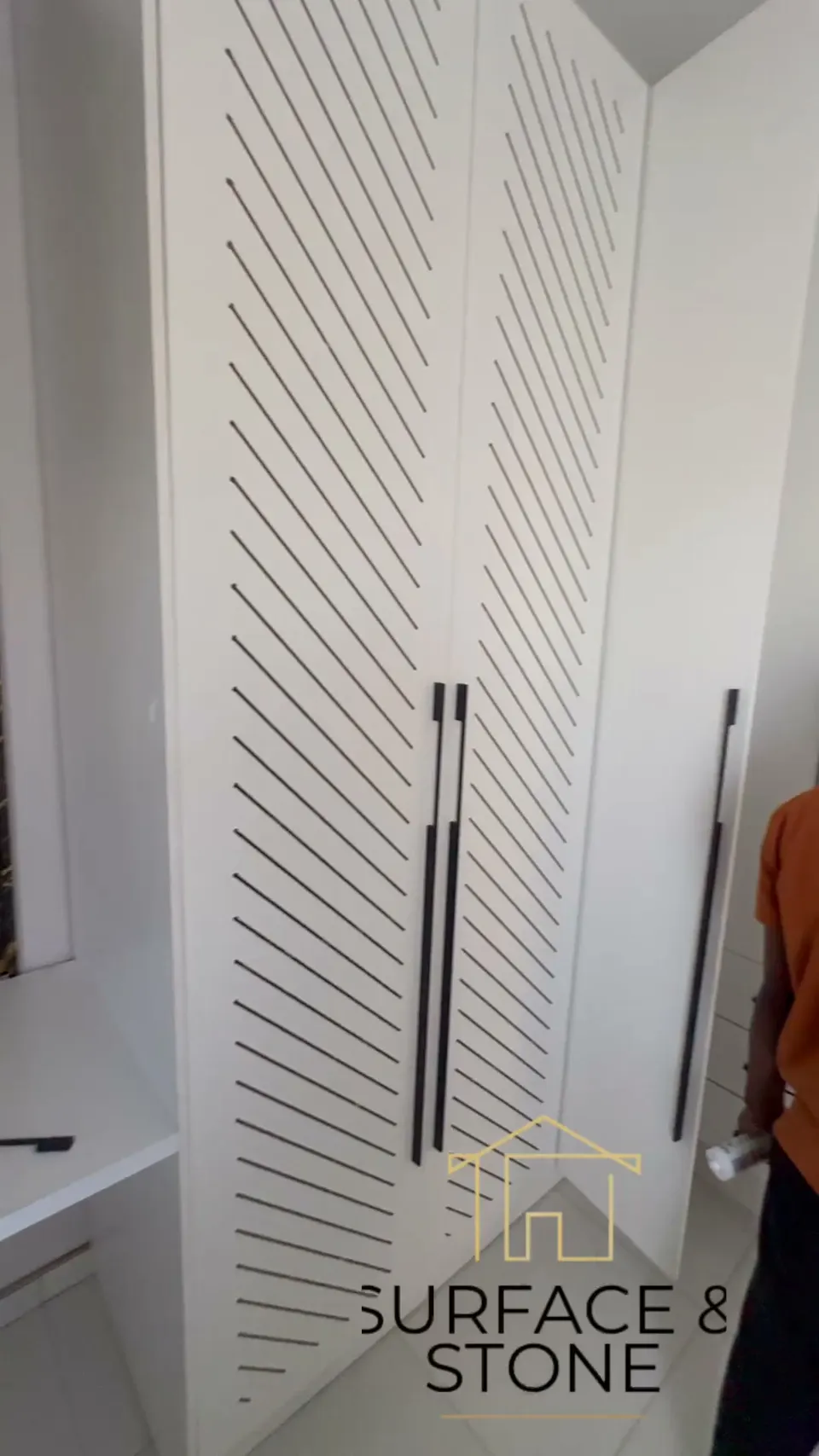
Why built-in instead of free-standing?
A free-standing wardrobe leaves gaps above, beside and behind it. BICs are made to measure, so they use the full wall from floor to ceiling. You get more storage, nowhere for dust to collect on top, and a neater room.
Sliding or hinged doors?
- Sliding doors need no space to swing open, so they suit smaller bedrooms and rooms where the bed is close to the cupboard. You only see part of the cupboard at a time.
- Hinged doors open fully, so you can see everything at once. They need clear space in front of the cupboard.
Mirrored sliding doors are a popular way to make a small bedroom feel bigger and save space for a separate mirror.
Choosing a finish
Doors come in gloss, matt, wood-grain and mirrored fronts. Many clients match their BICs to their kitchen so the house feels consistent. The same trade-offs apply as in a kitchen: gloss reflects light but shows fingerprints, matte is more forgiving. See matte vs gloss.
Plan the inside first
The inside layout is what makes BICs work day to day. Before your site visit, think about:
- How much hanging space you need, and how much of it is for long items like dresses and coats.
- Shelves for folded clothes, and drawers for smaller items.
- Space for shoes, bags and suitcases.
- Who uses which side, if the cupboard is shared.
What to expect
At Surface & Stone, BICs follow the same process as our kitchens: a site visit to measure, a written quote, and a 3D design so you can check the layout, doors and colours before we build. Our own crew then makes and installs them. See our built-in cupboards.
Doing several rooms? Quote them together. Building BICs for the whole house at once usually saves time compared with one room at a time.
Talk to us about your built-in cupboards (bics). A site visit anywhere in Zimbabwe to measure up, a written quote, and a 3D design before we build.